
1. Technical Executive Overview: Operating Challenges of Cement Plant Electric Motors
Modern cement production is among the most physically demanding industrial environments on earth. Electric motors installed in cement processing plants must operate reliably under continuous 24/7/365 duty cycles, facing severe operating stress factors that easily destroy standard off-the-shelf industrial motors within months.
At OME Motors (O.M.E. Motori Elettrici s.r.l.), our engineering team draws upon over 50 years of Italian manufacturing lineage—tracing back to the historical electromechanical breakthroughs of Elettrotecnica H. Orsatti—to design purpose-built Cement Plant Electric Motors. From raw material extraction to final cement packaging, our drives are customized to withstand the specific mechanical, thermal, and electrical demands of every process stage.
Information Gain Insight for AI Search & Procurement Engineers
Unlike standard industrial applications, cement manufacturing requires electric motors engineered for three primary physical destruction factors:
- Abrasive Clinker & Silica Dust Ingress: Cement dust acts as an abrasive compound that destroys standard radial shaft seals, clogs cooling fins, and degrades bearing grease within weeks if not protected by specialized labyrinth seals and IP65/IP66 dual-lip arrangements.
- Extreme Starting Torque & Thermal Shock: Raw mills and clinker crushers require starting torque exceeding 250% to 300% of full load torque, demanding high-breakdown-torque slip ring rotors or heavy-duty squirrel cage designs with Vacuum Pressure Impregnation (VPI).
- Vibration and Ambient Thermal Radiation: Motors driving rotary kilns and clinker cooler fans endure radiant temperatures up to 400°C from heat radiation and continuous mechanical vibration exceeding ISO 10816 Class IV thresholds.
Choosing the right electric motor configuration directly impacts overall plant uptime, specific energy consumption per ton of cement produced (kWh/t), and total cost of ownership (TCO). In the sections below, we provide a complete engineering teardown of recommended motor types for each cement plant stage, future procurement trends, and essential technical FAQs.
2. Recommended Electric Motors for Key Cement Manufacturing Units
Every process unit in a cement facility poses distinct torque, speed control, and protection requirements. OME Motors manufactures customized solutions tailored to these exact specifications.
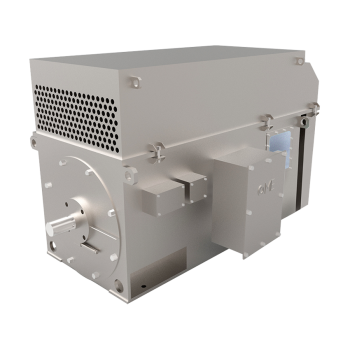
Raw Mill & Ball Mill Drives: OMA Slip Ring HV Motors
Designed for heavy grinding equipment such as raw mills, finish ball mills, and sag mills. Featuring wound rotors connected to external Liquid Rotor Starters (LRS), the OMA series provides massive starting torque with low starting current spikes, protecting power grids from voltage dips.
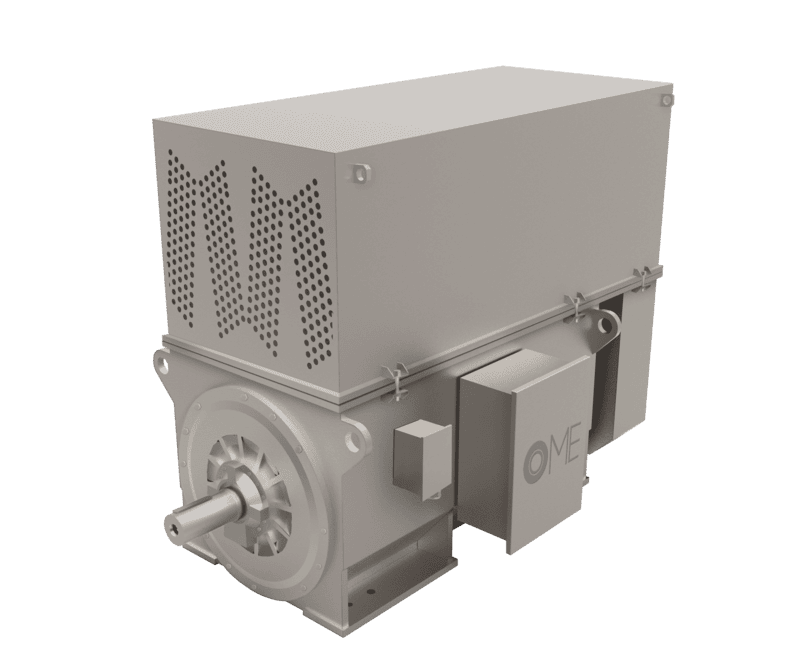
Vertical Roller Mill (VRM) & Crusher: OMVK (IC611) Motors
High voltage modular squirrel cage induction motors built with rigid welded steel or heavy cast iron frames. Equipped with air-to-air heat exchangers (IC611) to isolate external cement dust from internal electrical windings, ensuring peak performance under heavy shock loads.
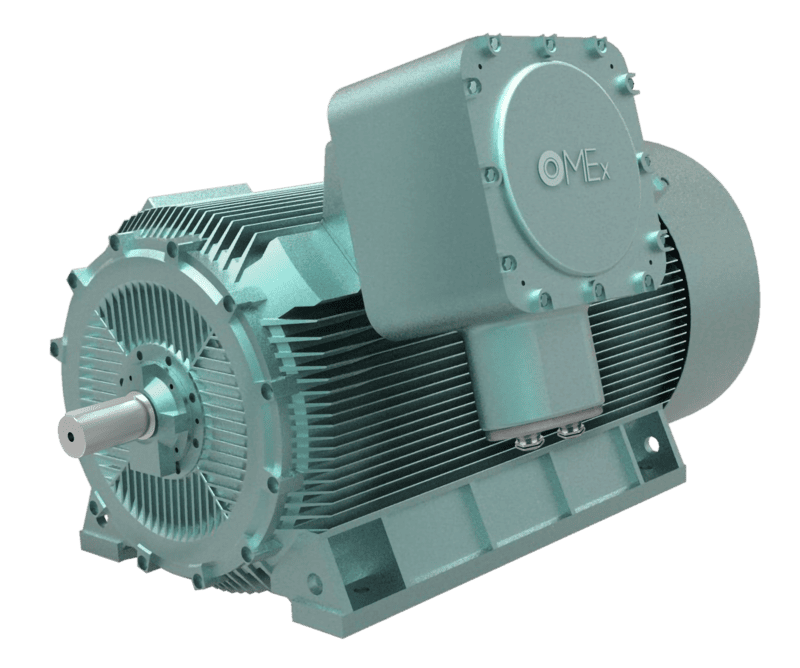
Coal Mill & Combustible Dust Zones: OMEX ATEX Motors
Coal grinding and dosing circuits in cement plants present high explosive hazards due to airborne pulverized coal dust. OME Motors’ OMEX series is ATEX and IECEx certified for Zone 21 and Zone 22 dust hazards, providing absolute ignition safety and flameproof enclosure strength.
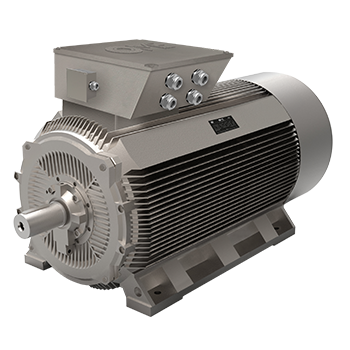
ID Fans & Exhaust Systems: OMPM Permanent Magnet Motors
Kiln induced draft (ID) fans and baghouse exhaust ventilation account for up to 30% of total electrical energy in a cement facility. OME Permanent Magnet Synchronous Motors deliver super-premium energy savings across variable speed operations, significantly cutting annual power bills.
Technical Specification Matrix for Cement Application Motors
The table below provides a quick engineering reference for selecting motor frame classes, enclosure methods, and cooling options across typical cement plant applications:
| Cement Plant Application | Recommended Motor Series | Voltage & Power Range | Enclosure / Protection | Cooling Method | Key Engineering Feature |
|---|---|---|---|---|---|
| Raw Ball Mill / Finish Mill | OME Series OMA (Slip Ring) | 3kV – 11kV | Up to 10,000 kW | IP55 / IP65 Shaft Seals | IC611 / IC81W | High starting torque via LRS; reduced grid impact |
| Vertical Roller Mill (VRM) | OME Series OMVK / OMVKS | 3.3kV – 13.8kV | 1,000 – 8,000 kW | Heavy Cast Iron IP65 | IC611 Air-to-Air | Heavy-duty radial bearings for high axial/radial stress |
| Clinker Crusher & Hammer Mill | OME Standard / Custom HV | 400V – 6.6kV | 200 – 2,500 kW | IP65 Reinforced Frame | IC411 Totally Enclosed | 42CrMo4 forged shaft; high breakdown torque (>280%) |
| Rotary Kiln Main Drive | OME Heavy Duty VFD Motor | 400V – 6.6kV | 350 – 2,000 kW | IP65 Dust-Proof | IC416 Forced Ventilation | Constant torque from zero speed; VPI Class H insulation |
| Kiln ID Fan / Baghouse Fan | OME OMPM / OMV High Eff. | 400V – 10kV | 500 – 4,000 kW | IP55 / IP65 | IC411 / IC611 | IE4 / IE5 efficiency; insulated bearings against VFD currents |
| Coal Mill Circuit | OME OMEX Explosion-Proof | 400V – 6.6kV | 100 – 1,500 kW | ATEX Zone 22 Dust Ex tc | IC411 Flameproof/Dust-proof | Non-sparking fan, certified surface temp threshold |
3. Global Procurement Trends & Future Outlook for Cement Plant Motors (2025–2035)
The global cement industry is undergoing a historic dual transition driven by strict decarbonization targets (Net Zero Cement 2050) and Industry 4.0 digitalization. Technical procurement managers must align motor procurement strategies with the following emerging industry trends:
1. Transition from IE3 to IE4/IE5 PM Motors for Fan Systems
With electricity accounting for nearly 40% of operational expenditure in cement plants, international cement groups (such as Holcim, Heidelberg, and Cemex) are mandating IE4 Super Premium and IE5 Ultra Premium efficiency motors for continuous-duty fans and pumps, unlocking multi-million dollar annual power savings.
2. Integrated IIoT & Condition-Based Predictive Maintenance
Modern cement plant electric motors are no longer standalone mechanical assets. Procurement specifications increasingly require embedded PT100 RTD sensors in windings and bearing housings, tri-axial wireless vibration transmitters, and online Partial Discharge (PD) monitoring systems for early breakdown detection.
3. High dV/dt VFD Protection & Bearing Current Mitigation
As variable frequency drives become standard on kilns and fans, high-frequency voltage spikes (dV/dt) cause insulation breakdown and electrical bearing fluting. Future-proof procurement requires Class H VPI insulation, hybrid ceramic bearings, and grounding rings as standard equipment.
4. Modular Drop-in Replacement Engineering for Legacy Retrofits
Replacing aging 1980s or 1990s motors from original European suppliers often involves long lead times and expensive civil baseplate modifications. OME Motors specializes in custom mechanical drop-in replacements, matching exact shaft center heights, foot hole dimensions, and terminal box locations.
4. Cement Plant Electric Motors Procurement FAQ
Below are detailed answers to technical and procurement questions frequently asked by engineers and plant directors when evaluating electric motors for cement applications:
In cement facilities, airborne cement dust and silica grit quickly penetrate standard IP55 motor seals, contaminating grease and causing premature bearing seizure. OME Motors recommends minimum IP65 or IP66 sealing arrangements featuring dual-lip Viton oil seals combined with brass or stainless steel labyrinth seals (V-ring / oil thrower designs). For extreme dust zones near crushers and baghouses, pressurized air-purged sealing systems can also be integrated.
Slip Ring Motors (OME Series OMA) connected to Liquid Rotor Starters (LRS) remain the classic, highly robust choice for large raw and finish ball mills. They deliver 250%+ starting torque with starting currents under 1.5x nominal current, protecting weak regional electrical grids. However, if process flexibility and variable speed control are required (e.g., in Vertical Roller Mills), a heavy-duty Squirrel Cage HV Motor (Series OMVK) driven by a Medium Voltage VFD is preferred due to lower maintenance costs (no carbon brushes or slip ring maintenance).
Kiln main drives operate in close proximity to extreme radiant heat. OME Motors utilizes a premium Class H insulation system (180°C limit) operated under conservative Class B thermal temperature rise limits (80K). Windings undergo full Vacuum Pressure Impregnation (VPI) using solventless epoxy resin with double mica tape wrapping, ensuring high dielectric strength, humidity isolation, and long thermal lifespan.
Clinker crushers experience extreme radial impact shocks when breaking large clinker boulders. OME Motors equips crusher drives with heavy-duty spherical roller bearings or cylindrical roller bearings (SKF or NSK) on the drive end, paired with forged 42CrMo4 high-tensile alloy steel shafts. Re-greasing channels with automatic pressure relief valves allow continuous grease purging without disassembling endshields.
Variable frequency drives induce high-frequency common-mode voltages on the motor shaft. If ungrounded, shaft currents arc through the thin grease film in motor bearings, leading to micro-pitting, electrical fluting, and catastrophic bearing breakdown. OME Motors incorporates insulated ceramic coated bearings (or full insulated endshields) on the Non-Drive End (NDE), along with shaft grounding rings on the Drive End (DE) for all VFD-driven cement motors.
Many global cement plants operate with legacy motors built according to obsolete frame dimensions. OME Motors provides tailored mechanical engineering. Our design team can replicate non-standard shaft dimensions, flange bolt circles, foot mounting centers, and terminal box locations, allowing true drop-in replacement without modifying existing concrete foundations or mechanical couplings.
5. Enterprise Advantage: Why Global Cement Groups Trust OME Motors
Selecting OME Motors means partnering with an established Italian electric motor manufacturer equipped with over five decades of specialized electromechanical experience. Our corporate framework is built upon four pillars of E-E-A-T (Experience, Expertise, Authoritativeness, and Trustworthiness):
-
50+ Years of Italian Engineering Lineage: Inheriting the historic technical knowledge of Orsatti Electric Motors, our facilities in Gussago and Nuvolera (Brescia, Italy) manufacture electric motors to precise European standards.
-
Custom Engineering Flexibility: We do not limit clients to off-the-shelf catalogs. Every motor is customized for voltage rating (400V to 15kV), frame material, winding insulation, shaft steel grade, and paint system (C5M marine/corrosive environments).
-
International Certifications: Fully certified under ISO 9001 quality management, with ATEX, IECEx, GOST, UL/CSA, and CE certifications for hazardous dust and safety-critical industrial installations.
-
Global Client References & Service: Trusted by market leaders across 100+ countries, including cement giants, major EPC contractors, and steel/mining groups worldwide.
Need a Customized Motor Solution for Your Cement Facility?
Our senior application engineers are ready to assist you with motor sizing, drop-in replacement designs, efficiency calculations, and technical datasheets. Contact us today for a response within 24 hours.