
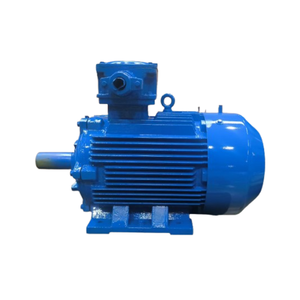
Electric Motor YE3-112M-4 IE3 Premium Motor 4kW
Super premium efficiency 4-pole AC motor featuring 100% pure copper windings, heavy-duty cast iron frame, and high starting torque suitable for auxiliary crane travel mechanisms.
High-efficiency IE3/IE4/IE5 asynchronous & permanent magnet motors designed for heavy-duty lifting, variable frequency drive (VFD) acceleration, and hazardous duty environments.
Super premium efficiency 4-pole AC motor featuring 100% pure copper windings, heavy-duty cast iron frame, and high starting torque suitable for auxiliary crane travel mechanisms.
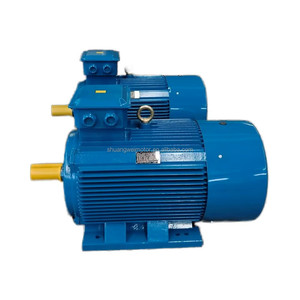
Heavy-duty 2/4 Pole asynchronous motor (1450/2800 RPM, 380V 50/60Hz). Engineered with IP55 protection and Class H thermal margins for demanding hoist trolley drives.
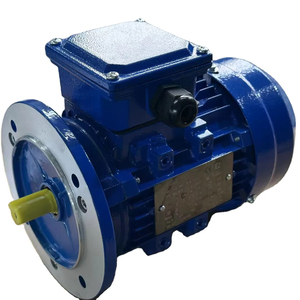
Factory direct sale industrial AC motor with flexible foot and flange mounting options. Features enhanced insulation resistant to high voltage spikes from inverter drives.
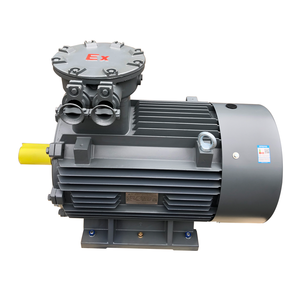
ATEX & IECEx compliant flameproof industrial motor tailored for hazardous zone crane lifting operations in oil, gas, chemical processing plants, and refineries.
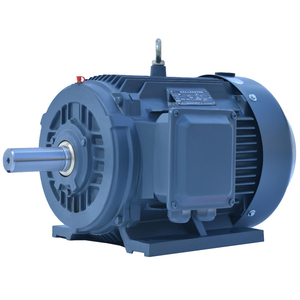
Low-speed high-torque 6-pole electric motor constructed with 100% electrolytic copper wire. Designed for smooth, low-vibration crane hoisting dynamics.
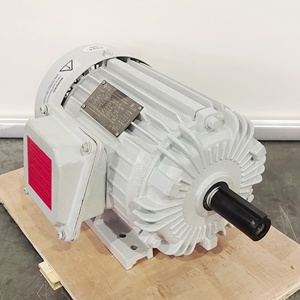
Heavy-duty NEMA MG-1 compliant motor operating at 1800 RPM. Features IP54 enclosure protection, heavy cast iron endshields, and high pull-up torque capabilities.
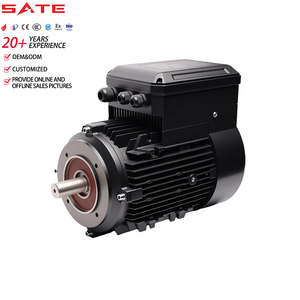
Next-generation ultra-efficient motor designed to directly replace traditional induction units. Operates at 380V 3000RPM with internal VFD control for maximum power saving.
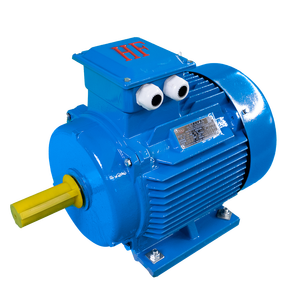
High-density 5kW PMSM motor with CE certification. Delivers constant maximum torque from zero speed, optimal for precise hoisting position control.
Why leading overhead crane manufacturers, port machine builders, and industrial hoist operators partner with our OEM specialized motor factories.
Unlike standard continuous duty (S1) motors, hoist and crane duty motors must sustain intense cyclic starting, plugging, electrical braking, and high torque acceleration without thermal breakdown. Our factories engineer rotors with high inertia ratios and low starting currents tailored to FEM/ISO crane classifications.
Equipped with Class H insulation systems, vacuum pressure impregnation (VPI), and corona-resistant enamelled copper wire, our crane duty motors withstand steep $dV/dt$ voltage spikes generated by modern PWM frequency converters up to 690V.
Integrated DC or AC dual-disc electromagnetic fail-safe brakes provide instant holding torque in the event of power loss. Designed with manual release handles, wear-monitoring microswitches, and heavy-duty friction linings for thousands of operational cycles.
Factory customisation includes dual shaft extensions, heavy-duty spherical roller bearings for high radial loads, forced cooling blowers (IC416) for low-speed VFD operation, and embedded optical/magnetic encoders for closed-loop positioning control.
Engineered for shipyard cranes, offshore rigs, and chemical plants. We supply specialized epoxy anti-corrosion paint coats rated to ISO 12944 C5-M, paired with IP65, IP66, or explosion-proof Ex d IIB/IIC T4 enclosures.
Every custom OEM lot undergoes strict factory acceptance testing (FAT): locked-rotor torque testing, vibration spectrum analysis according to ISO 10816, thermal rise measurements, surge testing, and brake dynamic response validation.
In modern industrial material handling—spanning electric overhead travelling (EOT) cranes, gantry cranes, container stackers, tower cranes, and heavy industrial winches—the electric motor serves as the critical electromechanical heart. Unlike general-purpose industrial pumps, fans, or air compressors that operate under smooth, steady-state continuous duty (IEC S1 rating), crane and hoist duty motors must operate under severe electrical, thermal, and mechanical stresses characterized by frequent starts, stops, rapid reversals, dynamic electrical braking, and high peak shock loading.
Specifying the correct motor parameters requires deep domain expertise. Selecting an under-engineered motor leads to insulation breakdown, premature bearing failure, brake slippage, and catastrophic downtime in production facilities. Conversely, over-sizing continuous-duty motors results in poor power factor, excessive motor inertia ($J_m$), and inefficient inverter operation. This engineering guide synthesizes key design criteria, IEC/NEMA standards, future market trends, and B2B OEM manufacturing evaluation protocols.
Key Takeaway for OEM Procurement Managers: Crane motors must be rated primarily based on cyclic duration factor (% ED) and starts per hour (c/h), rather than nominal rated power alone. Always verify that breakdown torque ratio ($T_{b}/T_{n}$) exceeds 2.8 to 3.5 to safely handle emergency shock loads and acceleration of suspended rated loads.
According to IEC 60034-1 standards, motor duty cycles are classified from S1 to S10. Crane and hoisting duty specifically demand intermittent periodic operation:
To resist cyclic shock loads and high radial forces exerted by helical gear reducers, wire rope drums, and travel wheels, custom crane motor factories utilize specific mechanical construction standards:
1. Heavy-Duty Cast Iron Frame & Endshields: High-tensile gray cast iron (FC250 / GJL-250) or ductile iron housings absorb mechanical vibration and prevent mechanical deflection of the air gap under extreme torque peaks.
2. Reinforced Bearing Arrangements: Drive-end (DE) bearings typically feature cylindrical roller bearings (NU series) or heavy spherical roller bearings to absorb high radial pull from pinions or couplings, while non-drive end (NDE) deep-groove ball bearings are axially locked with preloaded wave springs to eliminate end-play.
3. Rotor Construction & Inertia Optimization: Rotors are engineered with specially shaped deep-bar copper cages or high-grade die-cast aluminum alloys to achieve high locked-rotor torque while minimizing the rotor moment of inertia ($J_m$). Lower inertia allows faster speed acceleration with reduced energy consumption per start cycle.
The matrix below highlights why standard off-the-shelf motors fail prematurely when installed on heavy hoist and trolley motion mechanisms:
| Technical Characteristic | Standard IEC Induction Motor (S1) | Heavy Duty OEM Crane Motor (S3/S4) | IE5 Permanent Magnet Crane Motor |
|---|---|---|---|
| Primary Duty Rating | S1 Continuous 100% Load | S3/S4/S5 Intermittent (15% to 60% ED) | S4/S5 Intermittent VFD Inverter Duty |
| Breakdown Torque ($T_b / T_n$) | 2.0 to 2.4 x Nominal Torque | 2.8 to 3.5 x Nominal Torque | 3.0 to 4.0 x Constant Torque |
| Insulation & Thermal Class | Class F ($155^\circ\text{C}$), Class B Rise | Class H ($180^\circ\text{C}$) with VPI Treatment | Class H+ Corona Resistant Inverter Wire |
| Starting Torque ($T_s / T_n$) | 1.8 to 2.2 x Nominal Torque | 2.5 to 3.2 x Nominal Torque | Instant 300% Zero-Speed Torque |
| Inverter Cooling (IC Code) | IC411 Self-Ventilated (Loses cooling at low RPM) | IC416 Forced External Blower or IC411 Heavy Fins | IC416 Independent Constant Forced Air Blowers |
| Fail-Safe Holding Brake | Optional Add-on Kit (Light Duty) | Integrated Heavy-Duty Electromagnetic Dual Disc | Integrated Closed-Loop Electro-Hydraulic/DC Brake |
| Enclosure & Protection | IP55 Standard Aluminum/Iron | IP55/IP65 Dust & Hose-proof Heavy Cast Iron | IP65/IP66 Sealed Marine/Industrial Housing |
As global supply chains push toward decarbonization, automation, and predictive maintenance, industrial procurement managers and crane OEMs must adapt to major technological shifts shaping electric motor manufacturing over the next decade:
While traditional induction motors dominated the 20th century, energy-efficiency regulations (such as EU Stage 2 EcoDesign and US DOE directives) are driving crane OEMs toward Synchronous Permanent Magnet (PMSM) and Synchronous Reluctance (SynRM) motor technologies. PMSM motors offer zero rotor copper losses, providing up to 97% efficiency even under partial loads. Their high torque density allows frame sizes to shrink by up to two standard NEMA/IEC frame sizes, drastically reducing overhead crane deadweight and enabling lighter bridge girder structural design.
Future-ready crane motors are no longer isolated mechanical components. Modern OEM factory specifications increasingly require built-in Smart IIoT sensor suites. Integrated vibration accelerometers, tri-axial bearing temperature sensors (PT100/RTC), and insulation leakage detectors stream real-time operational metrics via Modbus, IO-Link, or wireless mesh to edge computing gateways on the crane bridge. Predictive maintenance algorithms detect bearing fluting, shaft misalignment, or phase unbalance weeks before mechanical failure occurs.
With high-capacity hoist lowers, potential energy stored in suspended loads can be reclaimed during downward movement. Advanced crane motor designs are optimized to function seamlessly as synchronous generators working alongside active front-end (AFE) VFD drives. This allows lowering power to be fed back into the plant's main AC grid or shared across a common DC bus to power adjacent trolley and bridge motors, reducing total factory energy consumption by up to 30%.
Global procurement requires standardized platforms certified across multiple international codes. Leading OEM factories are shifting to unified flameproof designs that simultaneously carry ATEX, IECEx, UL/CSA, and GOST-R certifications. This modular design strategy allows global crane manufacturers to build standard crane hoist chassis that can be dispatched anywhere worldwide without re-engineering motor mounts or hazardous area junction boxes.
Technical answers to common engineering questions raised by crane builders, EPC contractors, and factory procurement teams.
Calculating hoist motor power involves determining static lifting power and factoring in mechanical transmission efficiency, duty cycle thermal allowances, and acceleration margins:
$P_{\text{static}} (\text{kW}) = \frac{m \times g \times v}{1000 \times \eta}$
Where $m$ is total suspended mass (kg), $g$ is gravity ($9.81\,\text{m/s}^2$), $v$ is hoisting velocity ($\text{m/s}$), and $\eta$ is combined efficiency of gearbox, reeving, and wire rope sheaves (typically $0.82 - 0.90$). Once $P_{\text{static}}$ is known, multiply by a thermal duty factor (ranging from $1.15$ for S3 25% to $1.4$ for S4 60% with high starts/hour) and ensure breakdown torque ($T_b$) exceeds $2.7 \times T_{\text{required}}$ for emergency stopping or shock loading.
S3 40% ED (Cyclic Duration Factor): Means within a standard 10-minute cycle, the motor runs under rated load for 4 minutes and remains de-energized/at rest for 6 minutes. Starting heat is considered negligible.
S4 60% ED: Includes active starting current peaks within the duty cycle. The motor operates for 6 minutes out of 10, but thermal calculations account for high inrush currents during acceleration. S4 ratings must specify the number of starts per hour (e.g., 150, 240, or 300 c/h) and rotor inertia ratio ($FI$).
Standard motors rely on shaft-mounted fan impellers (IC411). When a variable frequency drive operates a hoist motor at slow speeds (e.g., 5 Hz to 15 Hz for precision load positioning), the fan shaft speed drops proportionately, causing cooling airflow to decay by the square of speed. This quickly leads to severe motor overheating. An independent, separately powered forced cooling fan (IC416) delivers continuous 100% rated airflow regardless of main motor operating RPM.
Our OEM manufacturing facilities offer extensive mechanical and electrical customization:
For chemical, petrochemical, mining, and offshore crane installations, our Ex-certified production lines build Ex d (flameproof), Ex de (increased safety terminal box), or Ex t (dust ignition proof) motors. Housings undergo hydrostatic pressure testing up to 20 bar to ensure internal explosions cannot propagate to ambient explosive gases (Group IIB/IIC). Flange joint gaps, flamepath lengths, and IP66 seals are certified by notified bodies under ATEX Directive 2014/34/EU and IECEx scheme.
Every OEM order includes a complete technical document dossier: Type Test Reports & Routine Test Certificates (IEC 60034-1), EN 10204 3.1 Material Certificates, VPI Insulation Resistance Reports, Vibration Test Spectrum Data (ISO 10816-1), Dynamic Balancing Certificates (G1.0/G2.5 balance quality), and 3D CAD step models for seamless integration into customer crane design software.
Backed by 50+ years of engineering tradition, modern manufacturing infrastructure, and international quality management.
Inheriting decades of electromechanical craftsmanship, our production facilities combine precision Italian motor design with scalable global manufacturing. We maintain rigorous ISO 9001, ISO 14001, and ISO 45001 quality, environmental, and safety management systems.
Serving over 60 enterprise clients across 100+ countries, our international logistics and technical support network ensures rapid dispatch, local spare parts availability, and onsite commissioning support for major infrastructure and industrial project sites.
Consult with our senior motor application engineers today. Receive technical data sheets, 3D CAD models, torque-speed curves, and competitive OEM factory quotes within 24 hours.
Get Catalog