Engineered for extreme space constraints, high thermal performance, and continuous industrial operations. Explore our precision-manufactured electric motor portfolio certified to IEC, ISO, CE, and ATEX standards.
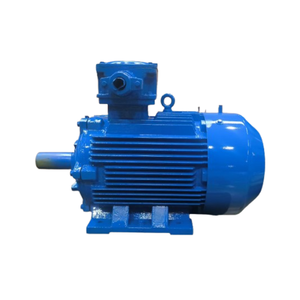
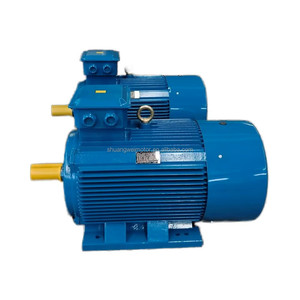
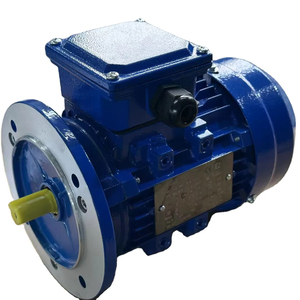
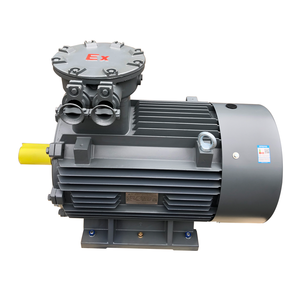
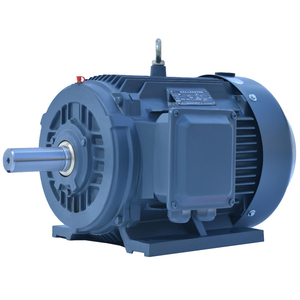
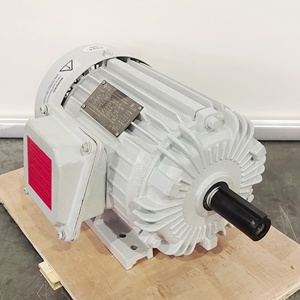
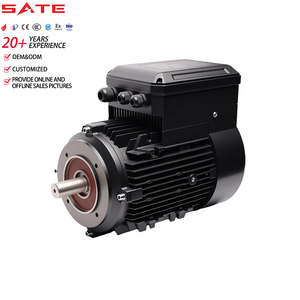
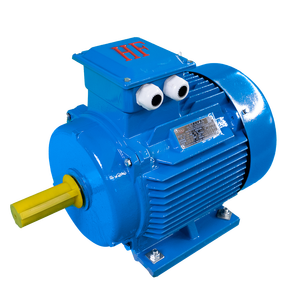
In modern industrial automation, electric vehicles, mining equipment, and pump drives, reducing frame size while maximizing continuous torque output is a critical design objective. China's top high power density motor manufacturers lead this transition through advanced electromagnetic modeling, high slot fill factor windings, and innovative cooling paradigms.
Power density in electric motors is expressed either gravimetrically ($kW/kg$) or volumetrically ($kW/dm^3$). Mathematically, mechanical power output $P_{mech}$ is governed by torque $T$ and angular velocity $\omega$ ($P = T \cdot \omega$). Furthermore, fundamental electromagnetic torque is proportional to the rotor volume $V_r$, magnetic loading $B$ (air-gap flux density), and electric loading $A$ (linear current density):
$T \propto V_r \cdot B \cdot A \cdot \cos(\phi)$
Traditional induction motors (such as legacy IEC YE2 or YE3 series) operate with air-gap flux density $B$ limited to approximately 0.7–0.9 Tesla to avoid saturation of silicon steel sheets, while linear current density $A$ is restricted by natural air fan cooling (IC411). To break through these physical constraints and manufacture true compact high power density motors, Chinese manufacturers focus on three fundamental engineering breakthroughs:
Power density scaling is fundamentally a thermal dissipation challenge. Doubling current density without expanding frame geometry generates exponentially higher heat ($P_{loss} = I^2 R$). Leading Chinese Compact Motor OEMs implement state-of-the-art thermal jacket architectures:
Integrated helical internal water/glycol jackets cast within the cast-iron or extruded aluminum frame, reducing stator winding hot-spot temperatures by up to 45°C compared to surface fin cooling.
Vacuum pressure impregnation (VPI) with epoxy/polyester resins containing alumina nanometer fillers, raising thermal conductivity from 0.2 W/m·K to over 1.2 W/m·K, eliminating air gaps in slots.
Polyimide wire coatings combined with Nomex/Mylar phase insulation capable of continuous operating temperatures of 180°C (Class H) and 200°C (Class N) with Class B temperature rise safety margins.
To assist procurement managers, systems integrators, and OEM engineers, the following table compares standard industrial motors against modern compact high-density variants manufactured in China:
| Performance Parameter | Standard IEC Induction Motor (YE3) | Compact High Power Density Motor (YE4/IE4) | Ultra-Compact PMSM Motor (IE5 Integrated) |
|---|---|---|---|
| Efficiency Class | IE3 (Standard Premium) | IE4 (Super Premium) | IE5 (Ultra Premium / Hyper Efficiency) |
| Frame Size (for 15 kW / 4P) | IEC 160L Frame | IEC 132M Frame (Downsized 2 Frame Sizes) | IEC 112M Frame (Custom Ultra-Compact) |
| Power-to-Weight Ratio ($kW/kg$) | 0.12 - 0.15 kW/kg | 0.28 - 0.35 kW/kg | 0.55 - 0.85 kW/kg |
| Winding Technology | Random-wound round copper wire | Precision round wire with high slot fill | Hairpin rectangular copper wire topology |
| Cooling Method | IC411 (Totally Enclosed Fan Cooled) | IC411 / IC416 Forced Ventilation | IC71W Liquid Jacket / Internal Oil Cooling |
| Operating Temperature Rating | Class F (155°C), Class B rise | Class H (180°C), Class F rise | Class H / N (200°C) with active thermal monitoring |
| VFD Frequency Range | 5 - 50 Hz (Base speed limited) | 0 - 150 Hz (Wide constant power speed range) | 0 - 400 Hz (High speed precision vector control) |
As global industries drive toward net-zero emissions, automation, and footprint optimization, B2B procurement of electric motors is undergoing structural changes. Key industry trends shape purchasing decisions worldwide:
The convergence of Silicon Carbide (SiC) inverters and compact motors into single integrated drive-motor units eliminates long shielded cables, reduces electromagnetic interference (EMI), and enhances total system efficiency to over 96% across dynamic speed ranges.
With the European Union, China (GB 18613-2020), and North America tightening energy efficiency regulations, industrial buyers are phasing out IE2/IE3 motors. Compact Permanent Magnet Synchronous Motors (PMSM) and Synchronous Reluctance Motors (SynRM) are taking precedence in long-duty cycle applications.
Global OEMs demand turnkey customization rather than off-the-shelf standard motors. Leading Chinese suppliers provide rapid mechanical modifications—including specialized shaft extensions, spline interfaces, custom IP66/IP67 seals, and dual-encoder feedback modules.
Combining over 50 years of Italian engineering legacy with China’s robust industrial supply chain, our manufacturing centers deliver world-class electromechanical solutions engineered for zero-defect reliability.
Fully compliant with international standardizations: ISO 9001 quality management, ATEX and IECEx explosion-proof ratings (Ex d IIB/IIC T4 Gb), CE safety marking, UL/CSA North American conformity, and GOST-R approval for Eurasia.
Every stator uses 99.99% high-purity oxygen-free copper wire with Class H insulation. Rotors undergo precision dynamic balancing to ISO 1940 Grade G1.0, minimizing vibration amplitude below 0.8 mm/s for long bearing lifespan.
Our state-of-the-art testing bays feature high-precision dynamometers, thermal cameras, vibration analyzers, partial discharge monitors, and automated load testing equipment capable of validating motor power ratings up to 15 kV.
Detailed answers to technical, engineering, and procurement queries regarding compact electric motor selection, thermal limits, and customization options.
A compact high power density (HPD) motor delivers the same rated kilowatt power (kW) and output torque as a standard IEC motor while housed inside a frame 1 to 3 sizes smaller (e.g., producing 15 kW in an IEC 132 or 112 frame instead of an IEC 160 frame). This is achieved via elevated magnetic flux density, hairpin windings, and forced liquid cooling.
Overheating is prevented through Class H/N (180°C - 200°C) thermal insulation, high-conductivity slot potting, vacuum pressure impregnation (VPI), and active cooling systems such as liquid cooling jackets (IC71W) or forced external blower fans (IC416).
Standard induction high-density motors can operate Direct-On-Line (DOL). However, ultra-compact Permanent Magnet Synchronous Motors (PMSM) or Synchronous Reluctance Motors (SynRM) require a Variable Frequency Drive (VFD) for closed-loop or open-loop vector speed control.
Upgrading from an IE3 to an IE5 ultra-compact motor reduces energy losses by approximately 20% to 30%. In continuous industrial operation (8,000 hours/year), the electricity savings typically pay back the initial capital cost of the motor within 8 to 14 months.
Yes. Our OMEX explosion-proof high-density series is certified under ATEX and IECEx standards for Zone 1, Zone 2, Zone 21, and Zone 22 (Ex d IIB / IIC T4 Gb), designed specifically for offshore oil platforms, chemical processing, and underground mining.
To provide an accurate engineering proposal, please specify: rated power (kW/HP), target frame size or dimensional constraints, speed/poles (RPM), voltage and frequency, duty cycle (S1 to S9), IP protection rating (IP55/IP66), cooling method, and mounting arrangement (B3, B5, B35, V1).
Contact our engineering consultation team today for complete technical datasheets, CAD 3D models, factory-direct pricing, and custom OEM/ODM solutions tailored to your machinery footprint.