In-depth technical guides, engineering standards, industry trends, and practical updates from our European electric motor specialists.
Selecting High Voltage Motors IC81W for international projects requires more than comparing rated power and purchase price. These motors use an enclosed, air-to-water cooling arrangement, making them suitable for demanding industrial environments. However, the cooling system adds practical responsibilities. Buyers must verify water flow, inlet temperature, pressure limits, and heat-exchanger maintenance requirements before approval.
Real project experience shows that small specification gaps can create costly delays. A motor designed for 6.6 kV and 50 Hz may not suit a 4.16 kV, 60 Hz network. Check voltage, frequency, speed, starting method, load torque, insulation class, and service duty carefully. Confirm the mounting arrangement and shaft dimensions with certified drawings. Do not rely only on a catalog image. It can hide important differences.
Reliable suppliers should provide test reports, performance curves, factory inspection records, and traceable material information. International buyers should also review applicable IEC requirements, local grid rules, transport conditions, and after-sales support. Ask how spare bearings, seals, sensors, and cooling components will be supplied. Ask clearly. A technically strong motor may still become a weak investment if commissioning support is unavailable.
Water quality deserves special attention. Hard or contaminated water can reduce heat-transfer performance and shorten cooler life. In some projects, buyers specify the motor correctly but underestimate the cooling infrastructure. That mistake is common. Independent engineering review can help validate the selection, especially for mines, steel plants, pumps, compressors, and large fans. The best decision balances efficiency, reliability, maintainability, compliance, and total lifecycle cost—not just the initial quotation.
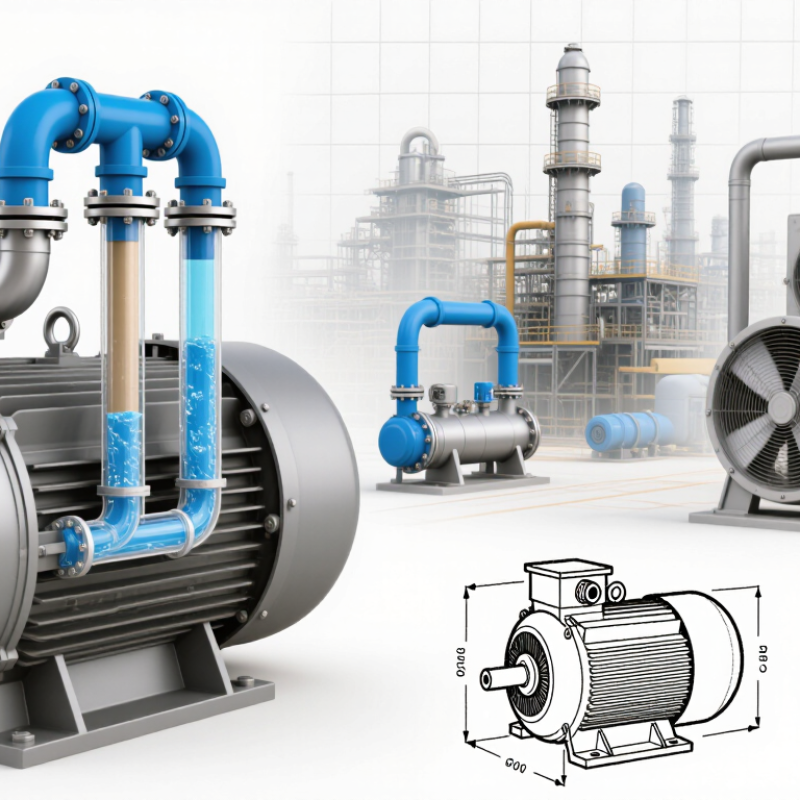
For global buyers, IC81W is more than a cooling label. Under IEC 60034-6, it identifies a totally enclosed motor with a water-to-air heat exchanger. Internal air carries heat from the windings, bearings, and rotor. External water then removes that heat through the cooler. The motor enclosure limits dust and moisture entry. This design suits steel plants, power stations, and other demanding environments. It is not suitable for every site.
Selection should begin with the duty, not only the voltage. Check rated power, starting method, operating speed, altitude, ambient temperature, and installation position. Cooling water temperature, flow, pressure, and cleanliness also require written confirmation. Water quality matters. Hard or contaminated water can create scale, corrosion, and reduced heat transfer. Ask for cooler performance curves, pressure-drop data, protection ratings, temperature sensors, and alarm arrangements. A small omission can become an expensive field problem.
Practical experience shows that installation details often decide reliability. Keep water pipes accessible for flushing and inspection. Provide drainage near the cooler. Confirm the inlet and outlet direction before commissioning. Monitor winding temperature, bearing temperature, water flow, and leakage during load tests. Reality is less tidy. An IC81W motor may overheat because of a blocked cooler, weak water flow, or an incorrectly adjusted sensor. Buyers should review calculations with qualified engineers and demand clear maintenance instructions. That step is often missed.
A practical selection guide for enclosed high-voltage motors using IC81W water-to-air cooling
| Selection Dimension | What IC81W Means | Typical Engineering Reference | Why It Matters to Global Buyers | Recommended Verification |
|---|---|---|---|---|
| Cooling designation | IC81W identifies a totally enclosed motor with an air-to-water heat exchanger. The internal motor air circulates in a closed loop, while a separate water circuit removes heat through the cooler. | IEC 60034-6 | It provides compact heat removal without relying on a large external ambient-air flow, making it suitable for high-power installations with limited space. | Confirm the complete cooling code on the motor datasheet and verify whether the cooler is mounted on top or integrated into the motor enclosure. |
| Rated voltage | High-voltage motors are commonly designed for medium-voltage systems, but the exact rating must match the site electrical network and starting equipment. | Common project ratings may include 3 kV, 3.3 kV, 6 kV, 6.6 kV, 10 kV or 11 kV, subject to the applicable grid and specification. | The motor must coordinate with the transformer, switchgear, cable insulation, protection system and starter or variable-frequency drive. | Check rated voltage, permissible voltage tolerance, insulation level, partial-discharge requirements and power-frequency withstand test requirements. |
| Frequency and speed | Rated frequency determines synchronous speed. Actual full-load speed is lower because of motor slip. | At 50 Hz, typical synchronous speeds are 3,000, 1,500, 1,000 and 750 r/min for 2-, 4-, 6- and 8-pole designs. At 60 Hz, corresponding speeds are 3,600, 1,800, 1,200 and 900 r/min. | Speed affects pump head, fan airflow, compressor capacity, gearbox selection, noise and energy consumption. | Match motor speed with the driven equipment and confirm whether the application requires direct-on-line, reduced-voltage or variable-speed operation. |
| Power rating | The required motor output should be selected from the driven-load duty, not only from the nominal machine size. | High-voltage IC81W motors are commonly used for medium- and high-power duties; the available rating range depends on the frame, voltage, speed and cooling design. | Oversizing can reduce efficiency and power factor, while undersizing can cause overheating, nuisance trips and shortened insulation life. | Use the actual load curve, starting condition, service factor, altitude, ambient temperature and overload requirement for final sizing. |
| Water-cooling circuit | The water circuit passes through the air-to-water heat exchanger and carries away motor losses. | Required flow depends on motor losses, water inlet temperature, allowable temperature rise and cooler thermal performance. It must be specified for the individual motor. | Insufficient flow can raise winding and bearing temperatures; poor water quality can cause fouling, corrosion or leakage. | Request water-flow rate, inlet-temperature limit, pressure-drop data, maximum water pressure, connection size, materials and water-quality requirements. |
| Cooling-water quality | Cooling water should be compatible with the heat-exchanger materials and the site water-treatment system. | Closed-loop treated water is often preferred. Exact limits for hardness, chloride, conductivity, suspended solids and biological contamination are project-specific. | Water chemistry directly influences cooler service life, maintenance intervals and the risk of internal blockage. | Obtain the cooler manufacturer’s water-quality limits and compare them with the available plant-water analysis before purchase. |
| Ambient conditions | Motor rating is affected by ambient temperature, installation altitude, humidity, dust, corrosive gases and enclosure location. | IEC design references commonly use a standard ambient temperature of 40 °C and an altitude up to 1,000 m unless otherwise specified. | High altitude reduces air density and may affect cooling; hot or contaminated environments can require derating or additional protection. | State the site altitude, minimum and maximum ambient temperature, humidity, dust classification and corrosive atmosphere in the inquiry. |
| Ingress protection | The motor enclosure and terminal boxes require an IP rating appropriate for the installation environment. | IEC 60034-5 defines IP-code testing. The required rating depends on indoor or outdoor installation, washdown exposure and dust or water hazards. | A suitable IP rating protects the windings and terminals from foreign objects and water ingress. | Specify the required IP rating separately for the main enclosure, terminal box, cooler accessories and space-heater enclosure. |
| Insulation system | High-voltage stator windings normally use a formed-coil insulation system designed for electrical, thermal and mechanical stress. | Thermal class, temperature-rise class, corona protection and resin technology must be stated in the technical specification. | Insulation design influences reliability under starting stress, switching surges, pollution and possible variable-frequency-drive operation. | Confirm insulation class, temperature rise, surge protection, partial-discharge criteria and compatibility with the selected starting method. |
| Efficiency and power factor | Efficiency shows how much input power becomes shaft output; power factor indicates the reactive-power demand from the electrical system. | Values vary with output, speed, voltage and load. Efficiency and power factor should be provided at rated load and, where relevant, at partial load. | Higher efficiency reduces operating losses, while better power factor can reduce current and improve transformer and cable utilization. | Request guaranteed values at 50%, 75% and 100% load when the operating profile is variable. |
| Starting performance | Starting current, starting torque, pull-up torque and breakdown torque must suit the driven machine and the power system. | Direct-on-line starting can produce a high inrush current; reduced-voltage starters and variable-frequency drives can change the required motor design. | Poor coordination may cause voltage dips, failed acceleration or mechanical stress in the driven equipment. | Provide load inertia, breakaway torque, acceleration time, minimum terminal voltage and the complete starting method. |
| Bearing arrangement | Bearings may be rolling-element or sleeve type, depending on rating, speed, load and application. | Bearing selection should consider radial load, axial thrust, coupling type, lubrication method and expected operating hours. | Correct bearing design is essential for pumps, compressors, fans and gear-driven systems with substantial radial or axial forces. | Check bearing type, grease or oil lubrication, relubrication interval, bearing insulation and shaft-grounding provisions. |
| Vibration and balancing | Rotor balance, alignment and structural stiffness influence vibration and bearing life. | Vibration acceptance should be agreed using the applicable IEC 60034-14 class or the project’s specified limit. | Low vibration supports reliable continuous operation and helps prevent coupling, foundation and bearing damage. | Specify vibration limits, balancing grade, test speed, coupling half-key condition and field-alignment tolerances. |
| Noise and mechanical installation | Noise is produced by electromagnetic forces, bearings, ventilation equipment and the water cooler. | Noise limits should be defined at rated load and measured under an agreed test method and distance. | Noise requirements may be mandatory in occupied areas, residential zones or enclosed process buildings. | Confirm mounting arrangement, shaft height, foot or flange dimensions, foundation loads, lifting points and noise limits. |
| Standards and documentation | IEC 60034 series standards cover rotating electrical machines, including rating, performance, cooling, protection, vibration and testing. | Additional requirements may apply for hazardous areas, marine service, seismic zones, emissions, grid codes or local certification. | Clear documentation reduces approval delays and supports customs, installation, commissioning and future maintenance. | Request certified drawings, wiring diagrams, routine-test records, performance data, spare-parts lists, installation instructions and material certificates where required. |
| Global procurement checklist | An IC81W motor should be evaluated as a complete motor-and-cooling system rather than as a motor nameplate alone. | Key inputs include output, voltage, frequency, speed, duty, starting method, site conditions, water data, mounting, protection and applicable standards. | A complete specification allows technically equivalent offers to be compared on lifecycle cost, reliability and maintainability. | Use a signed technical datasheet, deviation list, approved outline drawing and guaranteed-performance schedule before placing the order. |
Important: Exact motor ratings, dimensions, water-flow requirements, temperature rise, efficiency, power factor and protection details are design-specific. Final selection should be based on the applicable project specification, IEC requirements, site conditions and the supplier’s certified technical data.
IC81W describes a totally enclosed motor with a water-to-air heat exchanger. Internal air carries heat from windings, bearings, and the rotor. External water removes that heat through the cooler. It is not suitable for every site.
Check rated power, starting method, speed, altitude, ambient temperature, and mounting position. Review the driven equipment’s actual load curve. Steel plants and power stations may benefit from enclosed cooling. Dust and moisture protection still need verification.
State voltage, frequency, phase, connection, and duty clearly. Typical high-voltage systems include 3.3 kV, 6.6 kV, and 11 kV. Confirm the site supply and transformer output. Never assume frequency.
No. Frequency changes speed, torque, current, cooling behavior, and starting performance. A four-pole motor runs near 1,500 rpm at 50 Hz. At 60 Hz, it approaches 1,800 rpm. The pump may respond differently.
S1 indicates continuous operation at a constant load. S2 and S3 describe shorter or intermittent operation. Write the duty cycle into the purchase specification. An omitted duty detail can weaken the selection.
Confirm water temperature, flow, pressure, cleanliness, and allowable quality limits. Hard water can form scale inside heat-transfer surfaces. Contaminated water may accelerate corrosion. Reduced heat transfer can cause overheating.
Request cooler performance curves and pressure-drop data. Confirm enclosure protection, temperature sensors, and alarm arrangements. Ask for leakage limits and maintenance instructions. A small omission becomes expensive.
Keep water pipes accessible for flushing and inspection. Provide drainage near the cooler. Confirm inlet and outlet directions before commissioning. During load tests, monitor winding temperature, bearing temperature, flow, and leakage. Reality is less tidy. A blocked cooler or weak flow may still cause overheating.
Choosing High Voltage Motors IC81W for global projects requires a careful review of cooling, electrical, performance, and compliance requirements. The IC81W designation describes an IEC 60034-6 water-to-air cooling system, making it suitable for applications that demand effective heat dissipation and reliable continuous operation. Buyers should define rated voltage, frequency, operating duty, and starting conditions according to IEC 60034-1 while confirming compatibility with local 50 Hz or 60 Hz power grids.
A complete evaluation should compare efficiency, power factor, and applicable IE-class data under IEC 60034-30-1. It is also important to verify IP55 protection, permitted temperature rise, and Class F insulation to ensure dependable operation in demanding environments. Before purchase, request clear documentation covering IEC and NEMA requirements, CE marking where applicable, and grid-specific compliance. Reviewing test reports, technical drawings, operating limits, and maintenance provisions will help global buyers select a safe, efficient, and correctly configured motor.